
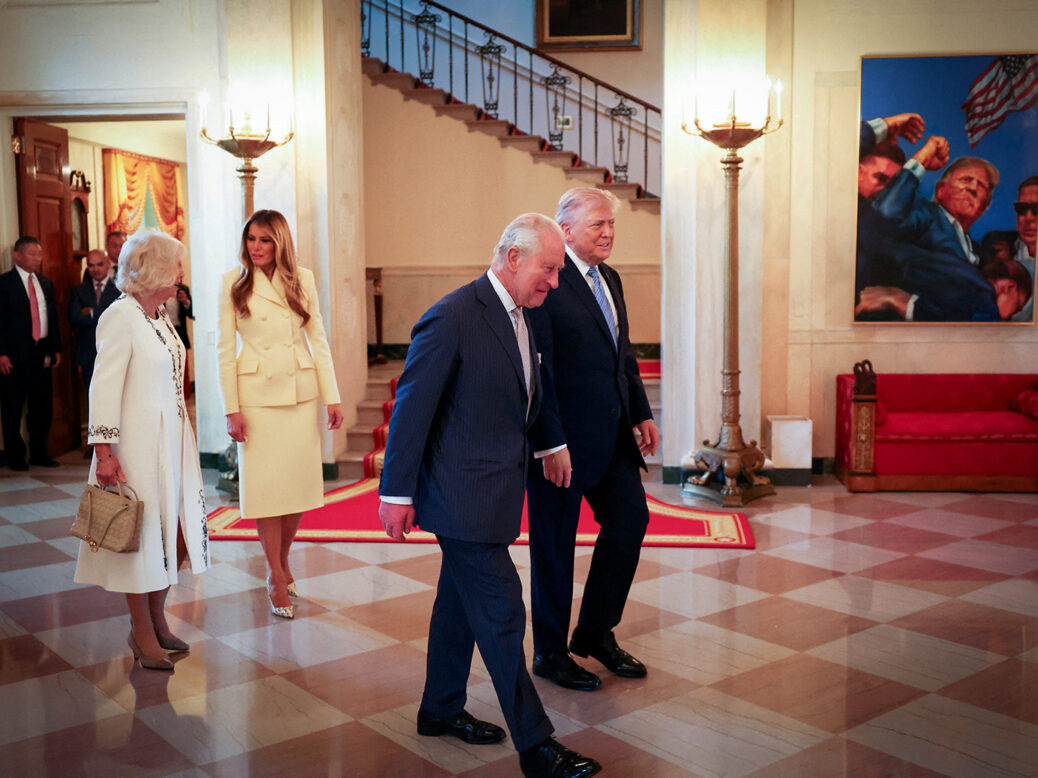
It was strange to watch the mightiest people in Washington DC shuffle around the lawn at the British embassy. Suddenly, these powerbrokers, militarist poachers of other countries’ heads of state, all the sundry warmongers and ideologues appeared… weak. They darted, pushed and strained in order to enter the regal orbit. We were told not to film with our phones, only for everyone to then hold their cameras in the air. King Charles, frail, wide-eyed but jolly, moved through the masses like a pope offering benediction.
He was there to mark 250 years since America’s independence from Britain, or what Gore Vidal once called the “war of separation” because “revolution is much too strong a word for that confused and confusing operation”. The House Speaker, Mike Johnson, Senator Ted Cruz and Trump aide Stephen Miller made the trip up Massachusetts Avenue. Luminaries were left waiting in a military-attaché-enforced line for 45 minutes without complaint. The only other person who inspires such restless manoeuvring in this town is the president – and he seems the most intoxicated by Charles.
Why does the British monarch have such a grip on the American imagination? When Charles first visited the US, as a gangly prince in 1970, Hugh Sidey wrote in Life magazine that President Nixon had “hired more bands and had more ceremonies… than any recent president in his intense but vain search for the magic which the prince and his sister carried along so casually”.
Something as ineffable as magic is only part of the explanation. Ask Americans to expand on this and they will tell you that they want a taste of something they can’t have. Many talk as if Charles III has as much power as George III. Embassy officials even had to remind senior administration officials of the King’s oblique influence in UK politics. You sense that they prefer the idea of Britain in the 18th century to the multi-ethnic, declining and impotent island they see today. When you don’t like the present, who better to revere than a person so symbolic of the past?

Some in the White House see Donald Trump’s state visit to Windsor last year as the highlight (so far) of his second term. But admiration for Charles is not universal. Trump is part of that dying breed of instinctive American Anglophiles. One US official joked speculatively to me about whether the King was a Muslim. Remember that more than 30 years ago Charles’s ecumenicism, as well as his personal preference for the mystical and esoteric, had led him to consider a change in his title from “Defender of the Faith” to “Defender of Faith”.
Charles was touted to me by one person as Britain’s “most experienced diplomat” – a salve for a wounded relationship. The British and American governments now squint across the Atlantic at each other with suspicion. The heady illusion ofa joint destiny that dominated the decade or so following 1991 now feels like a blip. Ahead of Charles’s visit, use of the phrase “special relationship” was banned at the British embassy, lest the country seem any needier than Keir Starmer did during his visit last year.
That was another time. Political pressure in Westminster from the isolationist left, coupled with Trump’s decision to go to war, has forced the Prime Minister into a more sceptical position. Starmer has switched from one of the most effusive displays of diplomacy in recent memory to laying the groundwork for a historic break.
Harold Wilson’s decision to stay out of Vietnam might have inspired Starmer’s reticence to join the war in Iran, but the wily pipe-smoker wasn’t above flattering presidents. In 1969, Nixon attended a private dinner at No 10, where he met John Freeman, the erstwhile editor of the New Statesman who was then the British ambassador to Washington. Freeman had once published a critical piece in the New Statesman about Nixon (he had even called him “a man of no principle whatsoever”) and the president wanted to clear the air. Nixon said the past is the past and “after all, he’s the new diplomat, and I’m the new statesman”. Wilson then slipped the president a note written on the back of the dinner menu: “You can’t guarantee being born a lord. It is possible – you’ve shown it – to be born a gentleman.”
Such gentlemanliness is now rare. But this constant dance between affection and disagreement is what Freeman’s affable modern counterpart, Ambassador Christian Turner, has tried to articulate in recent days. The argument is that Starmer and Trump have often taken separate sides, but something keeps the relationship ticking over. Officialdom wanted this trip to transcend the catty acrimony between No 10 and the White House, to offer something timeless that made eruptions such as the Iran war or the Britain’s blooming anti-Americanism look relatively transient.
The problem, of course, is that the historic bonds that sealed the relationship are slowly being forgotten. Newer memories (such as the Iraq War) are recalled bitterly. The old Anglophile Wasps who once held sway over America’s institutions – steeped in Henry James and polo and educated at Brit-style boarding schools such as Groton and Phillips Exeter – have been replaced by a more diverse cohort who don’t have much reverence for Britain. For now, at least, the King remains one of the few people Washington’s most powerful will crane their necks to see.
[Further reading: Fear and gunfire at the White House Correspondents’ dinner]
Content from our partners



Related


Join the debate
Subscribe here to comment